What is CNC Turning?

cnc turning
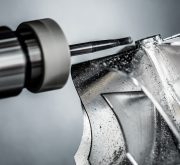
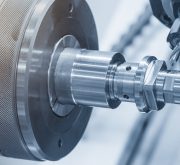
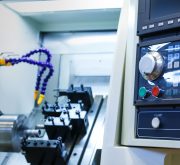
Let’s first work to give an understanding of turning. Turning is a machining process in which the workpiece (like a metal part) is rotated at a high speed, while a cutting tool is used to cut away the parts of the workpiece which aren’t needed. The cutting tool does not rotate, and it moves in a linear pattern. But, the cutting tool may move along a set of angles or curves.

Turning is normally done on the exterior surface of the workpiece, but sometimes it is also carried out on the inside. At that point, the process is known as boring. Similarly, cutting faces on the external side of the workpiece while it is rotating is known as facing.

Why is Turning Important?

In the manufacturing sector, the importance of turning is paramount. This is because engineers have to build complex designs which would not be possible without the process of turning. If you have ever inspected an assembly, you will understand why. In an assembly, there are literally thousands of parts interconnected with one another that also interact with each other to create a system. For example, an automobile can contain as many as 10,000 different parts.

All these parts are made of different types of materials and are of different sizes and shapes. Even the quality of the material varies with each part. All these parts are built by machinists using techniques like turning, casting, milling, welding, etc. Turning is carried out on a lathe machine.

How is it done?

As mentioned earlier, turning is done on a lathe machine. Being the oldest type of machine tool, a lathe machine is used to shape pieces of wood, metal, plastic, etc. During the process of turning, the workpiece which is usually rigid and made of either metal, wood, stone or plastic is rotated, while a cutting tool is moved along the workpiece in 3 different axes of motion in order to generate accurate depths and diameters.
There are four types of turning; profiling, straight turning, external grooving, and taper turning. These processes produce different types of shapes from a single workpiece like conical, curved, grooved or straight.

The Process

Turning can be done in either of two ways; manually or through the use of a computer. In the older days, turning was done by hand and the operator had to constantly monitor the process. It was time-consuming and inaccurate. With advancements in electronics and information technology, the use of computer-numerical control (CNC) became widespread and machines equipped with microcomputers were and are being used to conduct turning.

In CNC turning, a computer program is written by the operator with all the necessary dimensions and variables and the file is transmitted to the lathe machine. Using stepper motors to control the cutting tool, the machine automatically yields the best results. It is highly accurate, flexible, and quicker than doing it manually.
 

Sources
https://www.worldskills.org/what/career/skills-explained/manufacturing-and-engineering-technology/cnc-turning/
http://www.slideshare.net/APM_Longmont/what-is-cnc-turning
http://custommachining.ickler.com/blog/whats-the-difference-between-cnc-milling-and-cnc-turning
http://www.mnbprecision.com/what-is-cnc-turning/

What is a CNC Machine?

cnc machine
Machine tools to cut, shear, bore or grind metallic parts for use in the manufacturing sector have existed even before the Industrial Revolution. But early machine tools were driven by hand using levers and gears; later on, electric motors and hydraulic systems were used, and now computers are used to control them. Before understanding a CNC machine, it is better to have some know-how of what numerical control is.

Numerical control refers to using an algorithm or computer program to control a machine tool. In other words, a set of instructions containing numbers, symbols, and letters is used to program the machine to perform a certain task. Numerical control machines were invented in the 1940s and 1950s. Although electronics was still in its infancy, motors were utilized to guide the machine through a set of dots on a punched tape. Later on, digital computers were implemented. This gave rise to the modern CNC machine. CNC stands for computer numerical control.

The CNC Machine

A CNC machine consists of a microcomputer such as a microcontroller or a programmable logic controller (PLC), fitted on the machine itself, and programmed with a set of instructions to carry out the specified task.

The main difference between a numerical control machine and a computer numerical control machine is that numerical control involves the use of punch cards, whereas in computer numerical control, a computer is used. CNC machines store the program in their memory unit.
Mazak Variaxis machine

Benefits

CNC machines offer greater benefits over a traditional NC or numerical control machines. They are more flexible as they can be easily reprogrammed by a computer programmer to match the new job. Furthermore, they are cost-effective and much faster owing to the blazing speeds of modern computer processors. They also have more storage capacity and are highly accurate.

How do they Work?

CNC machines work exactly like robots; in fact, they are robots because they are automated and robots are controlled by computers as well. When the program or set of instructions are written to meet the requirements of the task such as cutting metal, the computer executes the commands and performs the task at hand. CNC machines work with drilling machines, lathe machines, turning machines, and milling machines.

Machining tasks like cutting metal parts to shape them require highly skilled operators; that can be expensive. On the other hand, CNC machines don’t need many people to run them. It just needs an operator who can write and load the program into the machine and fit it with the appropriate tools. After that, the machine takes over as the task is completely automated.
 
Sources
http://www.brighthubengineering.com/manufacturing-technology/55787-what-is-the-cnc-machine-how-cnc-machine-works/
http://www.thomasnet.com/about/cnc-machining-45330503.html
http://wings.buffalo.edu/academic/department/eng/mae/courses/460-564/Course-Notes/CNC%20notes.pdf
http://www.technologystudent.com/cam/cnccut1.html

What is a Machine Shop?

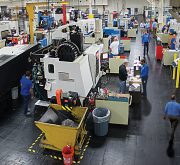
Interior panoramic of Kosmo Machine
There is some confusion when the term ‘machine shop’ pops up; some people think it is where a machine is produced. However, that’s not true. A machine shop is simply a place, location, building, company or room where machining is carried out. Machining refers to the cutting of raw materials in order to convert them to the desired size and shape.

Machining is done on metallic parts as well as plastic, ceramic, wood, and various composites. A person who performs machining it is called a machinist. Different types of hand tools, cutting tools, power tools, and machine tools are used in a machine shop. It can be done as a hobby, business or both. A machine shop can be a separate shop or a part of a large factory where manufacturing takes place.

The end product of a machine shop is a part which can be made of metal, plastic, wood, ceramic, etc. The parts are then sold to other manufacturing industries such as the automotive industry, aircraft industry, power generation industry, or shipbuilding industry.

What does a Machine Shop Consists of?

A machine shop typically consists of the following types of equipment for producing parts.

  • Milling machine
  • Metal lathe machine
  • Multitasking machine
  • Machining center
  • Grinding machine
  • Drill press
  • Welding machine
  • Inspection equipment

Machine shops often also contain the raw materials required for manufacturing the specific part, such as bar stocks. It also stores an inventory of the parts that have been finished.

Machine Shop as a Business

Setting up a machine shop is not easy. It requires a lot of capital as most of the machinery is expensive. Secondly, it requires skilled workers, especially if you are running a shop that specializes in repairing the components of engines, for example.

You might be imagining hundreds of workers laboriously working in a machine shop; well, the picture is somewhat accurate, but it doesn’t really hold true in modern times. Modern machine shops do not have masses of workers; many of the processes are automated and controlled by computers like robotics, microcontrollers, microprocessors, and PLCs. An example is the CNC machine commonly used in a machine shop.

History

Kosmo Machine shopBefore the Industrial Revolution of the 19th century, parts were manufactured in small cities, towns, and villages in local workshops. Then when factories began to spring up, most of the machines were constructed onsite. Before long, factories established their own machine shops.

Up till the early part of the 20th century, machine shops were powered by mechanical belts driven by steam engines. Later, electric motors took over. With the development of electronics, machine shops became automated with the introduction of numerical control. As computer technology advanced, it was integrated with the machine tools used in a machine shop and eventually, computer-aided design and manufacturing became popular.
 
Sources
http://www.practicalmachinist.com/vb/general/ot-what-does-small-machine-shop-actually-do-243051/
http://www.wisegeek.com/what-is-a-machine-shop.htm
http://www.me.berkeley.edu/services/student-machine-shop
http://www.dictionary.com/browse/machine-shop

Nashville Design2Part show on November 9-10, 2016

parts milled

Design 2 Part Show 2016Come see us at the Nashville Design2Part show on November 9-10, 2016.

“Attending Trade Shows is one of my favorite parts of the job”, says Mark Hayman, Director of New Business Development. Exhibiting at trade shows is an excellent opportunity for us on the sales team to show what Kosmo can do. In addition to showing what we can do, attending trade shows also helps us to keep up with the latest technology.

Bring us your machining challenges. We can offer solutions and develop relationships with the most demanding customers. Send your inquiries to: Kosmo@KosmoMachine.com

Continuous Improvement

career graphic
We are pleased to congratulate, Anthony and Kyle, our two most recent graduates of the NTMA-U Apprenticeship program.

Kosmo is proud to partner with the National Tooling and Machining Association (NTMA) and the Virginia Department of Labor to provide career growth for those who can meet the challenge. Great Job guys – Thank you!

The tradition continues as three more employees have made the commitment to complete the program.

Learn More About NTMA U

Job Fair

job fair blurred

Kosmo Machine Inc. will be holding a job fair at our location on Thursday, Sept. 8th, 2016 from 9AM-4PM. We are seeking to recruit experienced CNC Machinists with Mill and/or Lathe experience. Please note that qualified applicants must have Mill and/or Lathe experience in order to be considered.

We are recruiting for 1st and 2nd shifts. We offer medical/dental, Short Term Disability, Life Insurance, 401K, Tuition Reimbursement and weekly pay.

Come visit us at:

500 Trampton Road
Sandston, VA 23150